LEARNINGCLUES • 2025
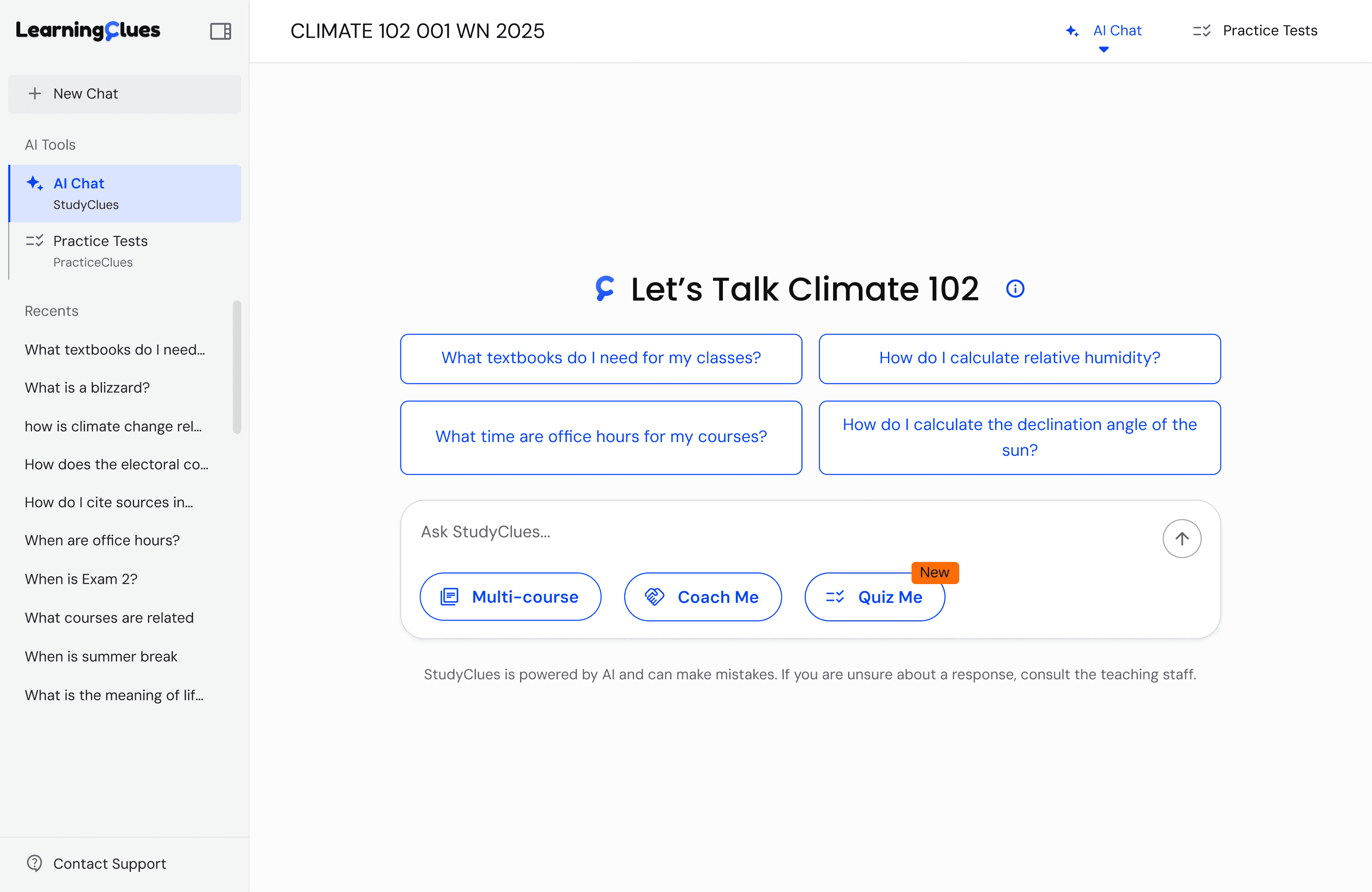
Going to market by enhancing usability and features of an LMS-based AI Chat.
ROLE
Sole Product Designer
COMPANY
A B2B AI startup that sells EdTech software to universities
TEAM
1 Designer (Me)
3 Engineers
1 CR Manager
SKILLS
Competitive Analysis, Prototyping, Accessibility, Design Systems
TOOLS
Figma, Claude, WAVE (Web Accessibility), PostHog
DURATION
Aug 2024 - Dec 2024
(4 months)
IMPACT
0→4 paying customers!
adoption rate
users asked at least 1 query
avg. monthly retention rate
TL;DR
I designed new search and conversational AI features, in-chat practice tests, and an interactive onboarding to boost user adoption and prevent academic misconduct.
FINAL DESIGNS


Multi-course mode to search across all courses in your program with citations to exact lecture moments and pages in course documents.

In-chat interactive practice test embeds to enhance feature set.

A click-through modal onboarding to address first-touch friction, and privacy concerns.
PROBLEM EXPLORATION
Identifying and prioritizing business, stakeholder, and end-user problems…
BUSINESS PROBLEM
Inability to convert pilots into paying customers.
Adoption rate
Weekly active students (% of enrolled)

LearningClues needed 18–22% adoption to convert pilots into paying clients.
STAKEHOLDER ADOPTION PROBLEM
Academic Integrity Concerns

Limited feature set,
strong competition


FINAL PROBLEM STATEMENT
StudyClues has low end-user adoption, and usability issues; stakeholders are concerned about academic misconduct and limited features — both are preventing LearningClues from converting pilots into paying customers.
CONSTRAINTS


IDEATION / ADDRESSING STAKEHOLDER ADOPTION PROBLEMS
Academic Integrity: What happens when students put homework questions in the chat?





How do we implement this coaching persona, then?
DESIGN EXPLORATIONS: COMPETITIVE ANALYSIS


SOLUTION / ACADEMIC MISCONDUCT
Enter Coach Mode
Auto-activates when homework question is detected
New conversational feature
Stakeholder approved!


IDEATION / ADDRESSING STAKEHOLDER ADOPTION PROBLEMS
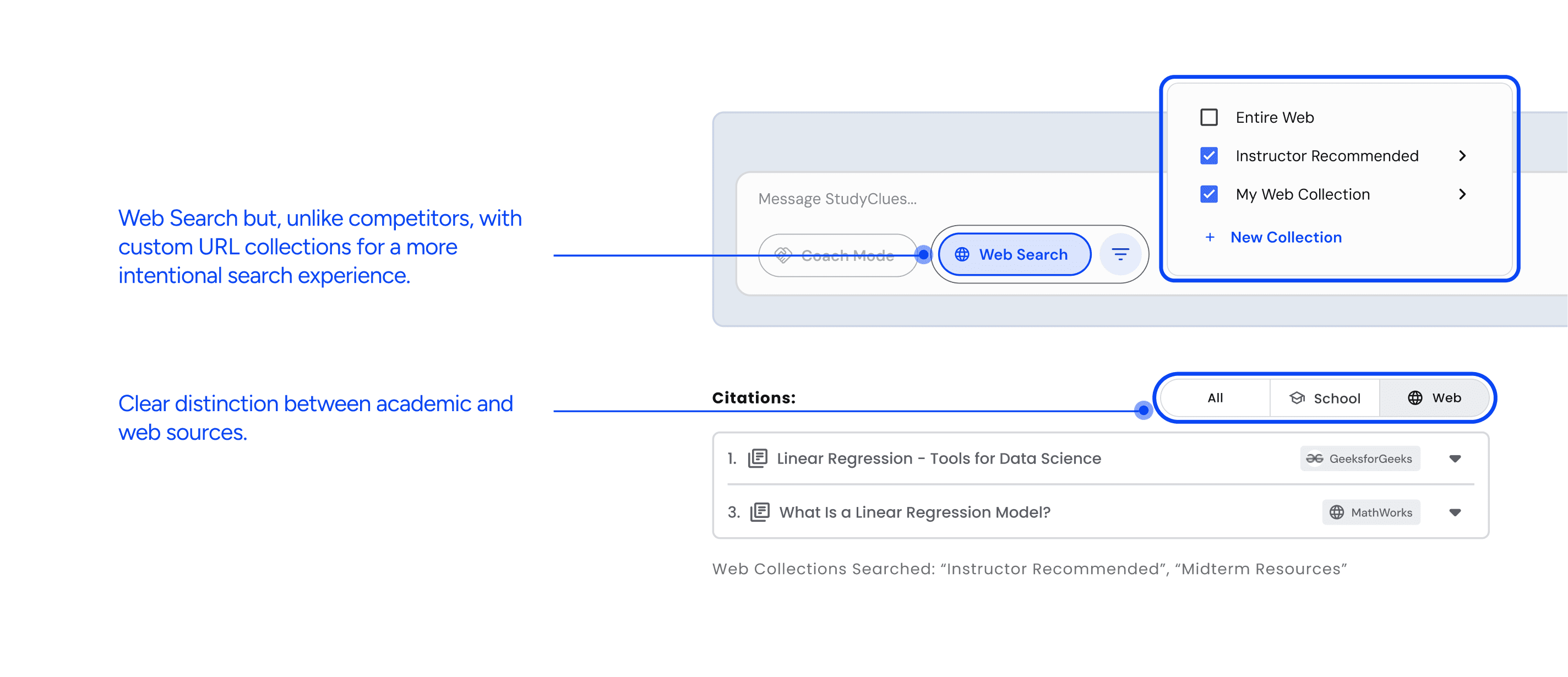
Limited Search Experience: How can we enhance our feature set?


EXPLORING TRADEOFFS

File Collections
✓ more personalized
✓ protects university IP
✘ too big of an engineering lift
✘ increased data storage costs
Multi-course Search
✓ easiest technical & cost lift
✓ existing access to student LMS data
✓ competitively unique
✘ not as broad of a search radius

Web Search
✓ competitive edge with URL collections
✓ already using OpenAI APIs
✘ too costly with no paying customers

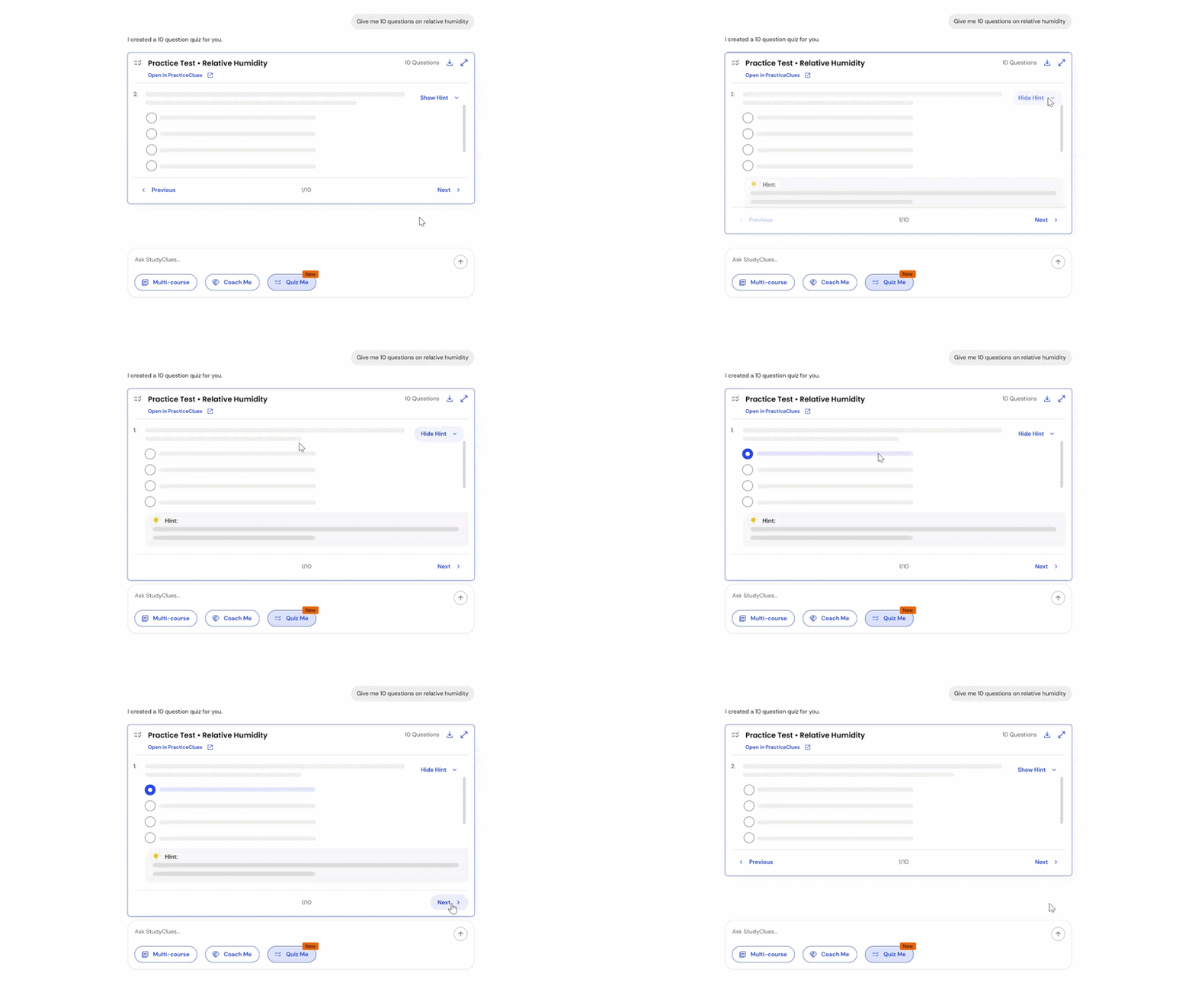
Quiz Mode
✓ students are asking StudyClues for practice questions
✓ aligns with technical roadmap
✓ citations to course videos
SOLUTION / ENHANCING FEATURE SET
Enter Multi-course Mode
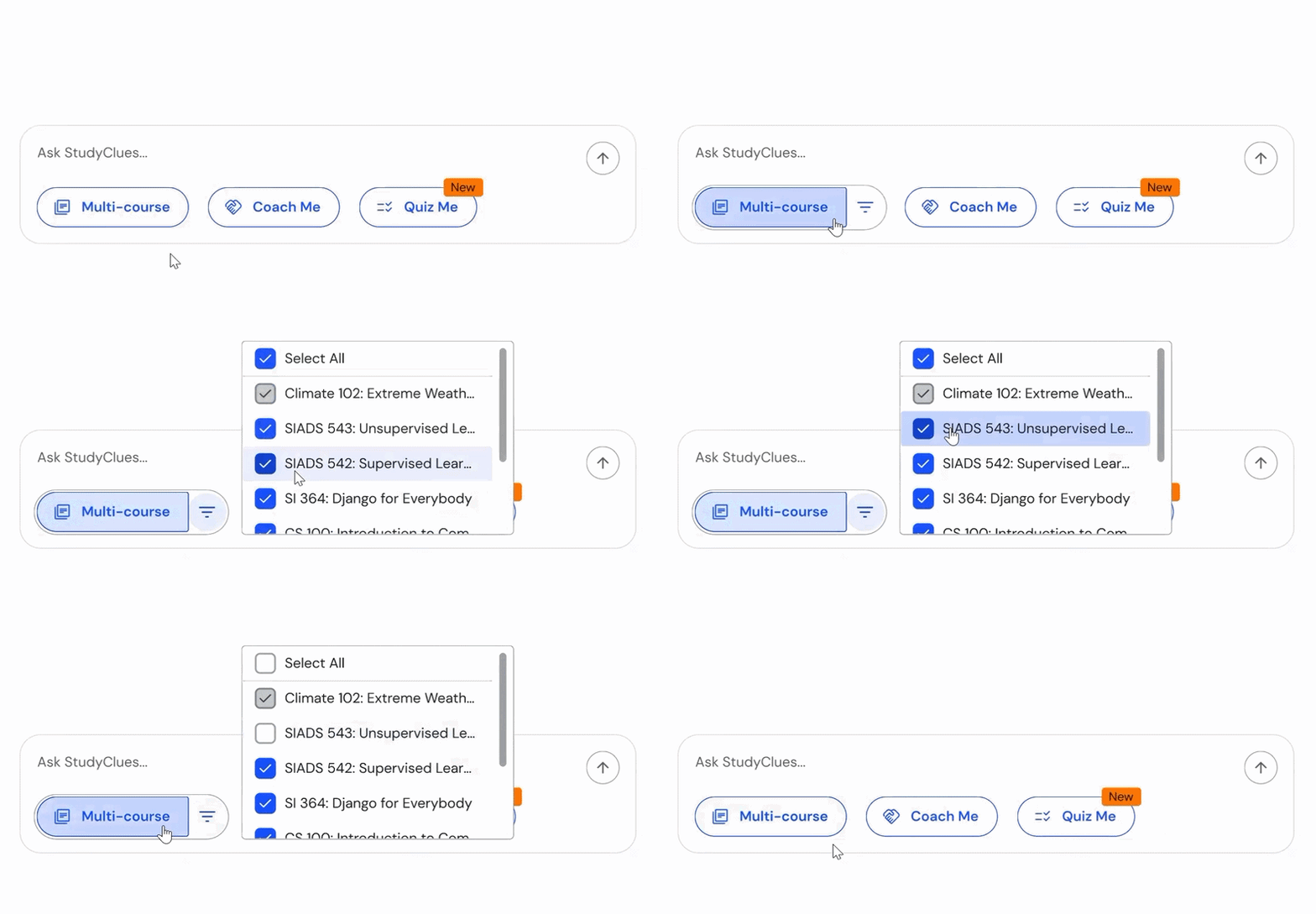
Stakeholder approved!
Enter Quiz Mode

An interactive in-line quiz embed with hints for guidance.

Quiz creation is broken down into a 3-step wizard for guided setup.

The quiz embed can be expanded into a side-panel for a more focused, full-screen view.
Each question explanation links directly to the exact lecture moment it's drawn from, for quick, in-context review.
Engineering & Stakeholder Approved!
IDEATION / ADDRESSING END-USER ADOPTION & USABILITY PROBLEMS
First-touch Friction: How can we prompt students to use StudyClues?
ADDRESSING FIRST-TOUCH FRICTION: OPTION #1
Instructor Publicity & Influence
Design StudyClues-specific class activities to help instructors demo use cases of the tool to students.


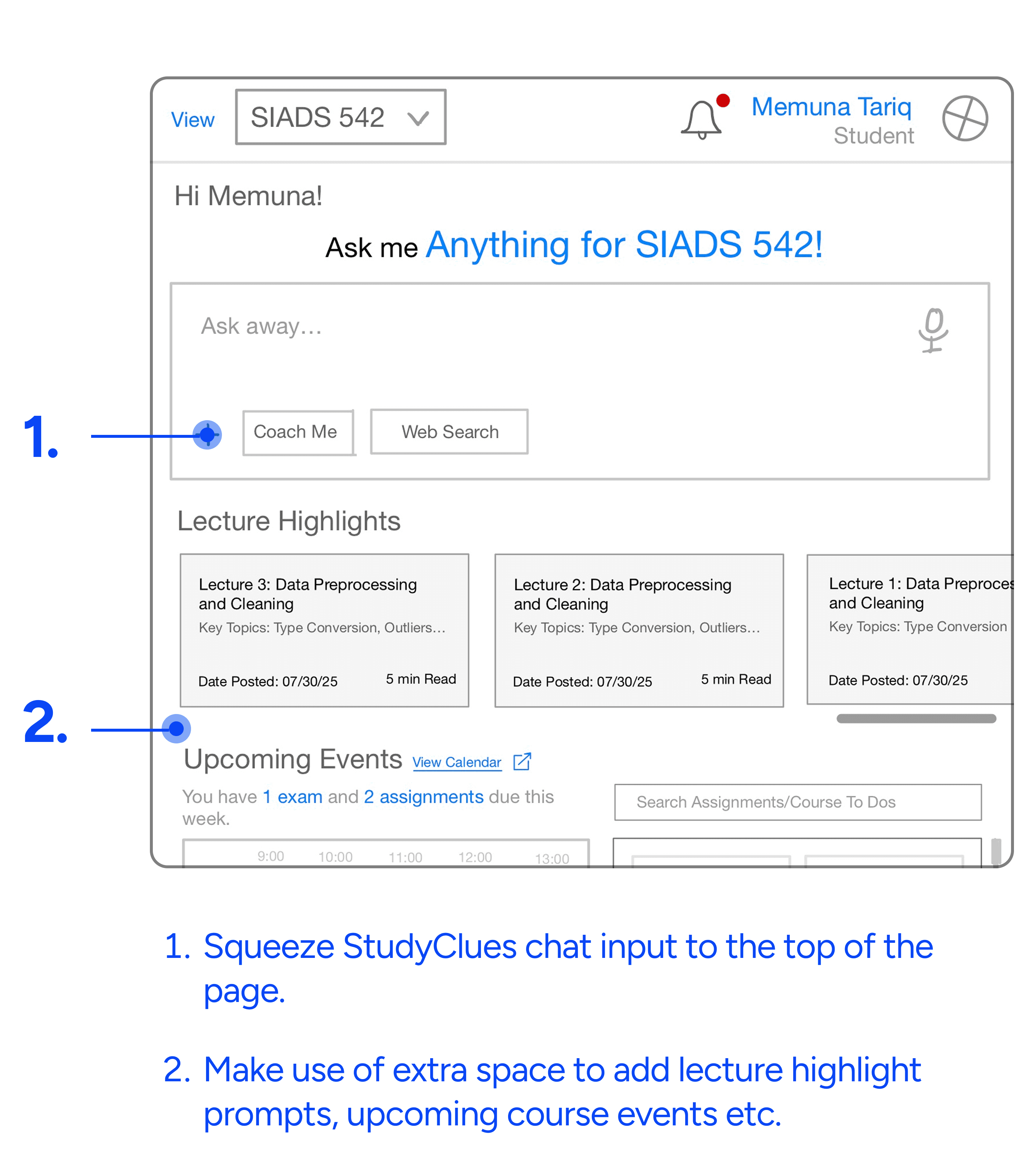
EXPLORING TRADEOFFS

Instructor Publicity
✓ students heavily influenced
✘ not all instructors willing
✘ extra work for instructor

Onboarding
✓ no external involvement from stakeholders req
✓ easiest to ensure students see it
✓ can be used to address privacy
✘ only a one-time thing

LMS Reminders
✓ Market potential use cases
✓ strategically remind students to keep coming back
✘ universities do not allow direct messaging students

Dashboard
✓ more personalized entry points to capture attention and nudge students into action
✓ can be combined with onb
✘ engineering cost is high
✘ instructors denied lecture highlights concept
SOLUTION / FIRST-TOUCH FRICTION
Enter Walkthrough Onboarding Flow

Engineers said NO :(
A walkthrough onboarding was too invasive for our current codebase.
Revised Modal Onboarding Flow (Iteration #2)

Engineering Approved!
Addresses privacy concerns in step 1
A click-through modal slideshow was easier to maintain long-term and used GIFs to mimic the same interactions.
IDEATION / ADDRESSING END-USER ADOPTION & USABILITY PROBLEMS
How can we improve feature discoverability?
DESIGN ALTERNATIVES

Iteration #1
Popular Questions accordion is open by default

Iteration #12
No Accordion. Popular Questions only appear at the start of each conversation.
✓ saves screen real estate
✓ aligns with past usage trends
SOLUTION / ADDRESSING END-USER ADOPTION & USABILITY PROBLEMS
How can we address privacy concerns?

An up-front privacy-disclaimer as the first non-skippable step of the onboarding flow.
FINAL SOLUTION
Bringing everything together…


FINAL DESIGN
Now for a visual refresh…


RESPONSIVENESS & ACCESSIBILITY
Ensuring designs are accessible even when zoomed up to 200%

OUTCOME
By driving a 22% adoption, I helped LearningClues go from 0→4 customers and achieve multiple new pilot partnerships!

Pictured alongside Perry Samson, CEO & Co-Founder @ LearningClues, presenting my work at EDTECH WEEK 2025 in NYC
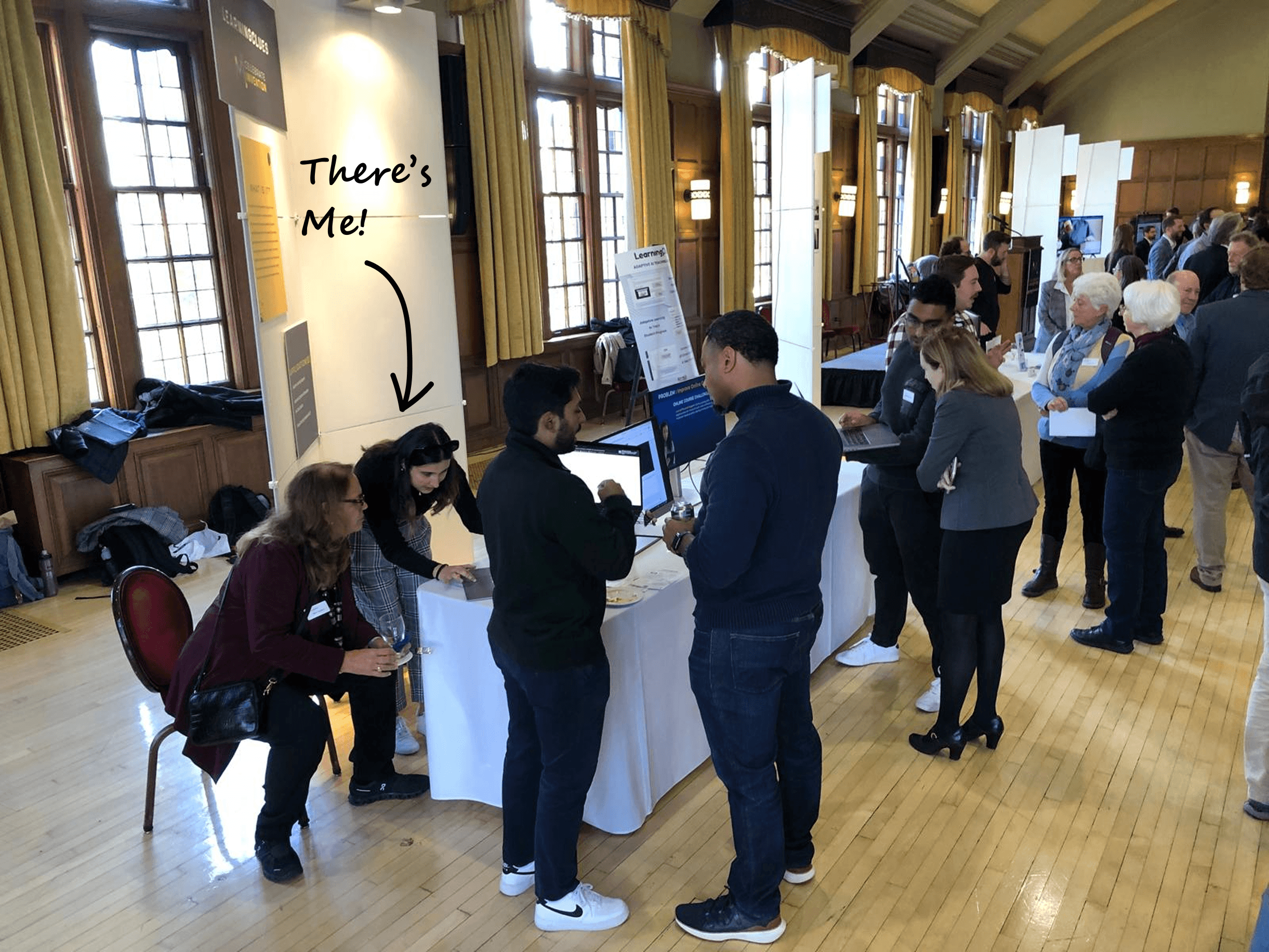
Demo-ing my LearningClues work to faculty and investors at the Michigan Invention Celebration, Nov 2024.
REFLECTIONS
What I would do differently
Leverage AI to explore more alternatives
How can we make StudyClues more agentic?
Suggesting context-aware follow-up questions?
Administer In-app Surveys
Record qualitative feedback from students through platform surveys to work around stakeholder user research barriers.
No direct evidence to confirm if privacy concerns were fully addressed.
Learning to anticipate and design around stakeholder policy restrictions…
Accessibility compliance can be time-consuming and a deal-breaker in B2B Edtech.
It's so important to design AI agents for trust, agency, and transparency.
Thanks for sticking till the end! :)